Test questions by topic
Citizenship test questions on elections and political parties
10 min readDiesen Ratgeber auf Deutsch lesen
Elections and parties are the biggest topic in the catalogue, with 44 questions. The most frequent themes are the electoral principles (free, equal, secret), who may vote in Bundestag elections (German citizens aged 18 and over), the four-year term, the second vote (Zweitstimme) and the 5% threshold. A second block is about parties and parliament: what CDU, CSU, SPD and FDP stand for, the terms coalition, parliamentary group (Fraktion) and opposition, and the “traffic light” coalition (Ampelkoalition). Finally there are practical questions about election day – the polling card, postal voting, which ballot paper is valid and what election workers do. Study tip: many questions come in two or three versions, for example on the Bundestag's term or the 5% threshold. Rather than memorising individual questions, learn the ten or so facts behind them – then you will recognise every version instantly.
What you should know
- Elections in Germany are general, direct, free, equal and secret (Article 38 of the Basic Law) – in the test the right combination is “free, equal, secret”.
- Free means no one may force or pressure you over whether or whom you vote for; voting is a right, not a duty.
- German citizens aged 18 or over may vote in Bundestag elections – being allowed to vote is called the active right to vote (aktives Wahlrecht).
- The Bundestag is elected for 4 years; at federal level the people elect only the Bundestag – the Chancellor is elected by the Bundestag and the Federal President by the Federal Convention.
- With the first vote (Erststimme) you choose a candidate in your constituency, with the second vote (Zweitstimme) a party – the more second votes, the more seats; the system combines majority and proportional representation, as our guide to elections in Germany explains.
- The 5% hurdle: a party needs at least 5% of the second votes (or three constituency seats) to enter the Bundestag, because many small parties would make forming a government harder.
- Before an election your municipality sends you a polling card (Wahlbenachrichtigung); you can also vote by post, and volunteer election workers count the votes once polling has closed.
- Parties that govern together form a coalition; a party's members in parliament form a parliamentary group (Fraktion); everyone outside the governing parties is the opposition, which scrutinises the government.
- CDU = Christian Democratic Union, CSU = Christian Social Union, SPD = Social Democratic Party of Germany, FDP = Free Democratic Party; a traffic light coalition (Ampelkoalition) is made up of the SPD (red), FDP (yellow) and Bündnis 90/Die Grünen (green).
- According to the current catalogue, the two largest groups in the Bundestag are CDU/CSU and AfD (question 73) – this answer can change after the next federal election.
The questions with the correct answer (44 questions)
Practise this topicQuestion 5
Elections in Germany are free. What does this mean?
Wahlen in Deutschland sind frei. Was bedeutet das?
- You may accept money if in return you vote for a particular candidate.
- Only people who have never been in prison may vote.
- Voters may neither be influenced nor forced to vote in a particular way, and must not suffer any disadvantage because of the election. – Correct answer
- All persons entitled to vote must vote.
In the test (German): Die Wählerin/der Wähler darf bei der Wahl weder beeinflusst noch zu einer bestimmten Stimmabgabe gezwungen werden und keine Nachteile durch die Wahl haben.
View this questionQuestion 13
In parliament, the term “opposition” refers to …
Im Parlament steht der Begriff "Opposition" für …
- the governing parties.
- the parliamentary group with the most members.
- all parties that managed to clear the 5% threshold in the last election.
- all members of parliament who do not belong to the governing party/parties. – Correct answer
In the test (German): alle Abgeordneten, die nicht zu der Regierungspartei/den Regierungsparteien gehören.
View this questionQuestion 28
Who elects the members of the Bundestag (federal parliament) in Germany?
Wer wählt in Deutschland die Abgeordneten zum Bundestag?
- the military
- the business community
- the people entitled to vote – Correct answer
- the administration
In the test (German): das wahlberechtigte Volk
View this questionQuestion 31
In Germany, the cooperation of parties to form a government is called …
Die Zusammenarbeit von Parteien zur Bildung einer Regierung nennt man in Deutschland …
- unity.
- a coalition. – Correct answer
- a ministry.
- a parliamentary group.
In the test (German): Koalition.
View this questionQuestion 41
Why is there more than one party in a democracy?
Warum gibt es in einer Demokratie mehr als eine Partei?
- because this allows the different opinions of citizens to be represented – Correct answer
- so that bribery in politics is limited
- to prevent political demonstrations
- to stimulate economic competition
In the test (German): weil dadurch die unterschiedlichen Meinungen der Bürgerinnen und Bürger vertreten werden
View this questionQuestion 44
Whom can you, as a citizen in Germany, not elect directly?
Wen kann man als Bürgerin/Bürger in Deutschland nicht direkt wählen?
- Members of the EU Parliament
- The Federal President – Correct answer
- Members of the state parliament (Landtag)
- Members of the Bundestag (federal parliament)
In the test (German): Die Bundespräsidentin/den Bundespräsidenten
View this questionQuestion 62
When the parliament of a German federal state is elected, this is called …
Wenn das Parlament eines deutschen Bundeslandes gewählt wird, nennt man das …
- a municipal election
- a state parliament (Landtag) election – Correct answer
- a European election
- a Bundestag (federal parliament) election
In the test (German): Landtagswahl
View this questionQuestion 73
The two largest parliamentary groups in the German Bundestag (federal parliament) are currently …
Die beiden größten Fraktionen im Deutschen Bundestag heißen zurzeit …
- CDU/CSU and AfD. – Correct answer
- Die Linke and Bündnis 90/Die Grünen.
- Bündnis 90/Die Grünen and SPD.
- Die Linke and CDU/CSU.
In the test (German): CDU/CSU und AfD.
View this questionQuestion 76
What does the abbreviation CDU stand for in Germany?
Was bedeutet die Abkürzung CDU in Deutschland?
- Christian German Union
- Club of German Entrepreneurs
- Christian German Environmental Protection
- Christian Democratic Union – Correct answer
In the test (German): Christlich Demokratische Union
View this questionQuestion 78
What does the abbreviation SPD stand for?
Was bedeutet die Abkürzung SPD?
- Socialist Party of Germany
- Social Policy Party of Germany
- Social Democratic Party of Germany – Correct answer
- Socially Just Party of Germany
In the test (German): Sozialdemokratische Partei Deutschlands
View this questionQuestion 79
What does the abbreviation FDP stand for in Germany?
Was bedeutet die Abkürzung FDP in Deutschland?
- Peaceful Demonstrative Party
- Free Germany Party
- Leading Democratic Party
- Free Democratic Party – Correct answer
In the test (German): Freie Demokratische Partei
View this questionQuestion 88
The parliamentary opposition in the German Bundestag (federal parliament) …
Die parlamentarische Opposition im Deutschen Bundestag …
- monitors the government. – Correct answer
- decides who becomes a federal minister.
- determines who sits in the Bundesrat (federal council).
- proposes the heads of government of the federal states.
In the test (German): kontrolliert die Regierung.
View this questionQuestion 89
In Germany, what is the association of a party's members in parliament called?
Wie nennt man in Deutschland die Vereinigung von Abgeordneten einer Partei im Parlament?
- Federation
- Council of Elders
- Parliamentary group – Correct answer
- Opposition
In the test (German): Fraktion
View this questionQuestion 92
What does the abbreviation CSU stand for in Germany?
Was bedeutet die Abkürzung CSU in Deutschland?
- Christian Secure Union
- Christian South German Union
- Christian Social Employers' Association
- Christian Social Union – Correct answer
In the test (German): Christlich Soziale Union
View this questionQuestion 93
The more “second votes” (Zweitstimmen) a party receives in a Bundestag (federal parliament) election, the …
Je mehr "Zweitstimmen" eine Partei bei einer Bundestagswahl bekommt, desto …
- fewer first votes (Erststimmen) it can have.
- more of the party's direct candidates enter parliament.
- greater the risk of having to form a coalition.
- more seats the party receives in parliament. – Correct answer
In the test (German): mehr Sitze erhält die Partei im Parlament.
View this questionQuestion 94
From what age are you allowed to take part in the election to the German Bundestag (federal parliament)?
Ab welchem Alter darf man in Deutschland an der Wahl zum Deutschen Bundestag teilnehmen?
- 16
- 18 – Correct answer
- 21
- 23
In the test (German): 18
View this questionQuestion 98
If members of the German Bundestag (federal parliament) change their parliamentary group, …
Wenn Abgeordnete im Deutschen Bundestag ihre Fraktion wechseln, …
- they may no longer take part in the sessions of parliament.
- the government may lose its majority. – Correct answer
- the Federal President must first give their consent.
- the voters of these members of parliament may vote again.
In the test (German): kann die Regierung ihre Mehrheit verlieren.
View this questionQuestion 103
What is referred to in Germany as a "traffic light coalition" ("Ampelkoalition")? The cooperation …
Was wird in Deutschland als "Ampelkoalition" bezeichnet? Die Zusammenarbeit …
- of the CDU and CSU parliamentary groups in the Bundestag (federal parliament)
- of SPD, FDP and Bündnis 90/Die Grünen in a government – Correct answer
- of CSU, Die LINKE and Bündnis 90/Die Grünen in a government
- of the CDU and SPD parliamentary groups in the Bundestag (federal parliament)
In the test (German): von SPD, FDP und Bündnis 90/Die Grünen in einer Regierung
View this questionQuestion 105
What is one task of election workers in Germany?
Was ist eine Aufgabe von Wahlhelferinnen/Wahlhelfern in Deutschland?
- They help elderly people cast their vote in the voting booth.
- They write the voter notification cards before the election.
- They pass on interim results to the media.
- They count the votes after voting has ended. – Correct answer
In the test (German): Sie zählen die Stimmen nach dem Ende der Wahl.
View this questionQuestion 106
In Germany, volunteer election workers help at elections. What is one task of election workers?
In Deutschland helfen ehrenamtliche Wahlhelferinnen und Wahlhelfer bei den Wahlen. Was ist eine Aufgabe von Wahlhelferinnen/Wahlhelfern?
- They help children and elderly people to vote.
- They write cards and letters stating the polling station.
- They pass on interim results to journalists.
- They count the votes after voting has ended. – Correct answer
In the test (German): Sie zählen die Stimmen nach dem Ende der Wahl.
View this questionQuestion 107
For how many years is the Bundestag (federal parliament) in Germany elected?
Für wie viele Jahre wird der Bundestag in Deutschland gewählt?
- 2 years
- 4 years – Correct answer
- 6 years
- 8 years
In the test (German): 4 Jahre
View this questionQuestion 108
In an election to the Bundestag (federal parliament) in Germany, anyone may vote who …
Bei einer Bundestagswahl in Deutschland darf jede/jeder wählen, die/der …
- lives in the Federal Republic of Germany and wants to vote.
- is a citizen of the Federal Republic of Germany and is at least 18 years old. – Correct answer
- has been living in the Federal Republic of Germany for at least 3 years.
- is a citizen of the Federal Republic of Germany and is at least 21 years old.
In the test (German): Bürgerin/Bürger der Bundesrepublik Deutschland ist und mindestens 18 Jahre alt ist.
View this questionQuestion 109
How often are there normally elections to the Bundestag (federal parliament) in Germany?
Wie oft gibt es normalerweise Bundestagswahlen in Deutschland?
- every three years
- every four years – Correct answer
- every five years
- every six years
In the test (German): alle vier Jahre
View this questionQuestion 110
For how many years is the Bundestag (federal parliament) in Germany elected?
Für wie viele Jahre wird der Bundestag in Deutschland gewählt?
- 2 years
- 3 years
- 4 years – Correct answer
- 5 years
In the test (German): 4 Jahre
View this questionQuestion 112
Elections in Germany are …
Die Wahlen in Deutschland sind …
- special.
- secret. – Correct answer
- occupation-based.
- gender-dependent.
In the test (German): geheim.
View this questionQuestion 113
In Germany, elections are won by the party that …
Wahlen in Deutschland gewinnt die Partei, die …
- gets the most votes. – Correct answer
- the majority of men voted for.
- got the most votes among workers.
- received the most first votes (Erststimmen) for its candidate for chancellor.
In the test (German): die meisten Stimmen bekommt.
View this questionQuestion 114
Taking part in democratic elections in Germany is …
An demokratischen Wahlen in Deutschland teilzunehmen ist …
- a duty.
- a right. – Correct answer
- a compulsion.
- a burden.
In the test (German): ein Recht.
View this questionQuestion 115
What does "active right to vote" ("aktives Wahlrecht") mean in Germany?
Was bedeutet "aktives Wahlrecht" in Deutschland?
- You can be elected.
- You must go and vote.
- You can vote. – Correct answer
- You must go to the counting of the votes.
In the test (German): Man kann wählen.
View this questionQuestion 116
If you are allowed to vote in an election to the Bundestag (federal parliament) in Germany, this is called …
Wenn Sie bei einer Bundestagswahl in Deutschland wählen dürfen, heißt das …
- active election campaign.
- active electoral procedure.
- active campaigning.
- active right to vote. – Correct answer
In the test (German): aktives Wahlrecht.
View this questionQuestion 117
What minimum percentage of the second votes (Zweitstimmen) must parties receive in order to be elected to the German Bundestag (federal parliament)?
Wie viel Prozent der Zweitstimmen müssen Parteien mindestens bekommen, um in den Deutschen Bundestag gewählt zu werden?
- 3%
- 4%
- 5% – Correct answer
- 6%
In the test (German): 5%
View this questionQuestion 119
Elections in Germany are free. What does that mean?
Wahlen in Deutschland sind frei. Was bedeutet das?
- No convicted offender is allowed to vote.
- If I want to go and vote, my employer must give me time off.
- Every person can decide without coercion whether they want to vote and whom they want to vote for. – Correct answer
- I can freely decide where I want to go to vote.
In the test (German): Jede Person kann ohne Zwang entscheiden, ob sie wählen möchte und wen sie wählen möchte.
View this questionQuestion 120
The electoral system in Germany is a …
Das Wahlsystem in Deutschland ist ein …
- census suffrage system.
- three-class suffrage system.
- majority and proportional representation system. – Correct answer
- universal male suffrage system.
In the test (German): Mehrheits- und Verhältniswahlrecht.
View this questionQuestion 121
A party wants to get into the German Bundestag (federal parliament). However, it must have a minimum share of the votes. This is called the …
Eine Partei möchte in den Deutschen Bundestag. Sie muss aber einen Mindestanteil an Wählerstimmen haben. Das heißt …
- 5% hurdle. – Correct answer
- admission limit.
- base value.
- guideline.
In the test (German): 5%-Hürde.
View this questionQuestion 122
Which principle do elections in Germany follow? Elections in Germany are …
Welchem Grundsatz unterliegen Wahlen in Deutschland? Wahlen in Deutschland sind …
- free, equal, secret. – Correct answer
- open, secure, free.
- closed, equal, secure.
- secure, open, voluntary.
In the test (German): frei, gleich, geheim.
View this questionQuestion 123
What is the "5% hurdle" in Germany?
Was ist in Deutschland die "5%-Hürde"?
- voting rule in the Bundestag (federal parliament) for small parties
- attendance check in the Bundestag (federal parliament) for votes
- minimum share of the votes in order to get into parliament – Correct answer
- attendance check in the Bundesrat (federal council) for votes
In the test (German): Mindestanteil an Wählerstimmen, um ins Parlament zu kommen
View this questionQuestion 124
The Bundestag election in Germany is the election …
Die Bundestagswahl in Deutschland ist die Wahl …
- of the Federal Chancellor.
- of the parliaments of the federal states.
- of the parliament for Germany. – Correct answer
- of the Federal President.
In the test (German): des Parlaments für Deutschland.
View this questionQuestion 125
In a democracy, one function of regular elections is …
In einer Demokratie ist eine Funktion von regelmäßigen Wahlen, …
- to force citizens to cast their vote.
- to make a change of government possible in line with the will of the majority of voters. – Correct answer
- to keep the laws existing in the country.
- to give the poor more power.
In the test (German): nach dem Willen der Wählermehrheit den Wechsel der Regierung zu ermöglichen.
View this questionQuestion 126
What do citizens in Germany who are eligible to vote receive before an election?
Was bekommen wahlberechtigte Bürgerinnen und Bürger in Deutschland vor einer Wahl?
- a voter notification card from the municipality – Correct answer
- a permit to vote from the Federal President
- a notification from the Federal Convention
- a notification from the parish office
In the test (German): eine Wahlbenachrichtigung von der Gemeinde
View this questionQuestion 127
Why is there a 5% hurdle in the electoral law of the Federal Republic of Germany? It exists because …
Warum gibt es die 5%-Hürde im Wahlgesetz der Bundesrepublik Deutschland? Es gibt sie, weil …
- the programmes of many small parties have a lot in common.
- citizens can lose their bearings when there are many small parties.
- many small parties make it harder to form a government. – Correct answer
- the small parties do not have enough money to pay the politicians.
In the test (German): viele kleine Parteien die Regierungsbildung erschweren.
View this questionQuestion 128
Members of parliament who are elected by the citizens are called …
Parlamentsmitglieder, die von den Bürgerinnen und Bürgern gewählt werden, nennt man …
- representatives. – Correct answer
- chancellors.
- ambassadors.
- Minister-Presidents.
In the test (German): Abgeordnete.
View this questionQuestion 129
In Germany, the people elect …
Vom Volk gewählt wird in Deutschland …
- the Federal Chancellor.
- the Minister-President of a federal state.
- the Bundestag (federal parliament). – Correct answer
- the Federal President.
In the test (German): der Bundestag.
View this questionQuestion 130
Which ballot paper would be valid in an election to the Bundestag (federal parliament)?
Welcher Stimmzettel wäre bei einer Bundestagswahl gültig?
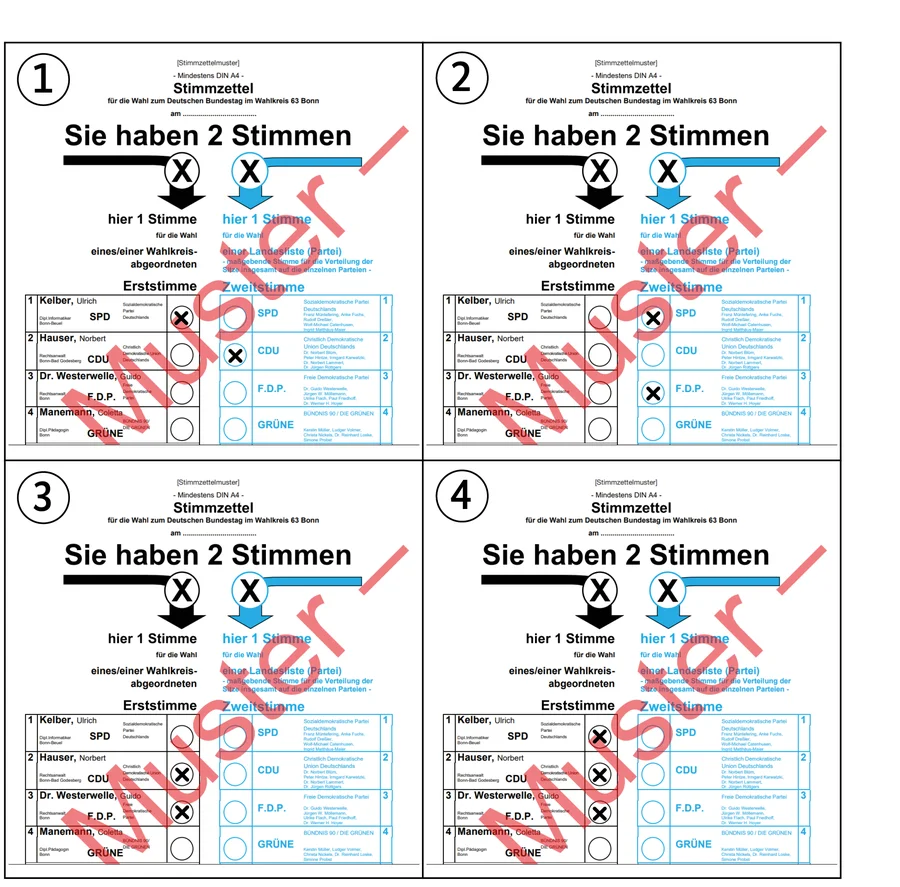
Image: In Anlehnung an Bundeswahlordnung (BWO), Anlage 26 - 1 – Correct answer
- 2
- 3
- 4
In the test (German): 1
View this questionQuestion 133
What is allowed in Germany in elections to the Bundestag (federal parliament) and to the state parliament (Landtag)?
Was ist bei Bundestags- und Landtagswahlen in Deutschland erlaubt?
- The husband also votes on behalf of his wife.
- You can cast your vote by postal ballot. – Correct answer
- You can cast your vote by telephone on election day.
- Children from the age of 14 are allowed to vote.
In the test (German): Man kann durch Briefwahl seine Stimme abgeben.
View this questionQuestion 134
There are plans to abolish the bus route that you always take to work. What can you do to keep the bus route?
Man will die Buslinie abschaffen, mit der Sie immer zur Arbeit fahren. Was können Sie machen, um die Buslinie zu erhalten?
- I take part in a citizens' initiative to keep the bus route or start an initiative myself. – Correct answer
- I join a sports club and train in cycling.
- I contact the tax office because, as a taxpayer, I have a right to the bus route.
- I write a letter to the municipality's forestry office.
In the test (German): Ich beteilige mich an einer Bürgerinitiative für die Erhaltung der Buslinie oder gründe selber eine Initiative.
View this question
More topics
Frequently asked questions
How many questions on elections are in the German citizenship test?
There's no fixed number. With 44 of the 300 general questions, elections and parties is our largest topic, so on average about 4 of your 30 general questions come from it – sometimes more, sometimes fewer.
At what age can you vote in Germany?
In Bundestag elections from 18, and only with German citizenship. In European elections the voting age in Germany is 16, and for local and state elections it depends on the federal state – but in the test, 18 is always the right answer for the Bundestag.
What is the difference between the first and second vote?
The first vote elects a candidate in your constituency; the second vote goes to a party list and decides how many seats each party gets. Since the 2023 reform the Bundestag has a fixed 630 seats, with no overhang or balancing seats.
Keep reading
- Knowledge for the testElections in Germany: first vote, second vote and the 5% thresholdHow federal elections work in Germany, what the first and second votes mean, who may vote and which electoral principles apply, explained simply.
- Knowledge for the testGermany's political system explained simplyBundestag, Bundesrat, federal government, president and constitutional court: who decides what in Germany, explained simply for the citizenship test.
- Test questions by topicCitizenship test questions on law and justiceCourts, police, penalties and public authorities: every citizenship test question on law and justice, with the correct answer and key facts.
This guide is not legal advice. Laws and administrative practice can change; your naturalisation authority's information is binding.