Test questions by topic
Citizenship test questions on the state and its institutions
8 min readDiesen Ratgeber auf Deutsch lesen
This part covers how the German state is organised and who does what. There are 43 questions on it – the second-largest topic in the catalogue after elections. Most are about the constitutional bodies: who elects the Federal Chancellor, what does the Federal President do, who sits in the Bundesrat (federal council)? You also need the separation of powers (legislature, executive, judiciary), federalism with its 16 federal states (Bundesländer), the three levels of Federation, states and municipalities, and a few one-off questions on the Bundeswehr, the Federal Cross of Merit and Germany's population. Study tip: sketch who elects and appoints whom – people → Bundestag → Chancellor; Federal Convention (Bundesversammlung) → Federal President. That one diagram answers around a dozen questions in which the Bundestag, Bundesrat and Bundesversammlung appear side by side as look-alike options.
What you should know
- Germany's full name is the Federal Republic of Germany (Bundesrepublik Deutschland); it has 16 federal states and about 84 million inhabitants – see our guide to the 16 states and their capitals.
- The state is organised into the Federation, the federal states and the municipalities; the lowest political tier is the municipality (Gemeinde), headed by a mayor.
- Every federal state has its own government, in most states led by a Minister-President (Ministerpräsident/in); school policy is mainly a matter for the states.
- Separation of powers: the Bundestag and Bundesrat form the legislature; the government, ministries, police and tax office the executive; and the courts with their judges the judiciary – the press is not a branch of state power.
- The Bundestag is the parliament for the whole of Germany, based in Berlin: it passes laws, scrutinises the government and elects the Federal Chancellor – but it does not form the cabinet.
- The President of the Bundestag is usually a member of the largest parliamentary group.
- The Federal Chancellor heads the federal cabinet; the ministers are appointed by the Federal President on the Chancellor's proposal.
- The Federal President is head of state, represents the country, proposes the Chancellor for election by the Bundestag and is elected by the Federal Convention (Bundesversammlung) – more in our guide to Germany's political system.
- The Bundesrat is made up of representatives of the state governments; through it the states take part in federal legislation, so a state election that changes the Bundesrat majority can make governing harder at federal level.
- The Federal Constitutional Court in Karlsruhe interprets the Basic Law; the questions on who is Chancellor and head of state today (question 72, question 75) depend on who currently holds office – check them shortly before your test.
The questions with the correct answer (43 questions)
Practise this topicQuestion 24
How many federal states does the Federal Republic of Germany have?
Wie viele Bundesländer hat die Bundesrepublik Deutschland?
- 14
- 15
- 16 – Correct answer
- 17
In the test (German): 16
View this questionQuestion 25
Which is not a federal state of the Federal Republic of Germany?
Was ist kein Bundesland der Bundesrepublik Deutschland?
- Elsass-Lothringen – Correct answer
- Nordrhein-Westfalen
- Mecklenburg-Vorpommern
- Sachsen-Anhalt
In the test (German): Elsass-Lothringen
View this questionQuestion 32
What is not a branch of state power in Germany?
Was ist keine staatliche Gewalt in Deutschland?
- Legislation
- Government
- The press – Correct answer
- Administration of justice
In the test (German): Presse
View this questionQuestion 37
What are the heads of government of most federal states in Germany called?
Wie werden die Regierungschefinnen/Regierungschefs der meisten Bundesländer in Deutschland genannt?
- First Minister
- Prime Minister
- Senator
- Minister-President – Correct answer
In the test (German): Ministerpräsidentin/Ministerpräsident
View this questionQuestion 39
What does every German federal state have?
Was hat jedes deutsche Bundesland?
- its own foreign minister
- its own currency
- its own army
- its own government – Correct answer
In the test (German): eine eigene Regierung
View this questionQuestion 42
Who passes a new law in Germany?
Wer beschließt in Deutschland ein neues Gesetz?
- the government
- the parliament – Correct answer
- the courts
- the police
In the test (German): das Parlament
View this questionQuestion 46
The German state has many tasks. Which task is one of them?
Der deutsche Staat hat viele Aufgaben. Welche Aufgabe gehört dazu?
- It builds roads and schools. – Correct answer
- It sells food and clothing.
- It provides all residents with newspapers free of charge.
- It produces cars and buses.
In the test (German): Er baut Straßen und Schulen.
View this questionQuestion 47
The German state has many tasks. Which task is not one of them?
Der deutsche Staat hat viele Aufgaben. Welche Aufgabe gehört nicht dazu?
- It pays for holiday trips for all its citizens. – Correct answer
- It pays child benefit.
- It supports museums.
- It sponsors athletes.
In the test (German): Er bezahlt für alle Staatsangehörigen Urlaubsreisen.
View this questionQuestion 48
Which body is not one of Germany's constitutional bodies?
Welches Organ gehört nicht zu den Verfassungsorganen Deutschlands?
- the Bundesrat (federal council)
- the Federal President
- the citizens' assembly – Correct answer
- the government
In the test (German): die Bürgerversammlung
View this questionQuestion 49
Who determines school policy in Germany?
Wer bestimmt in Deutschland die Schulpolitik?
- the teachers
- the federal states – Correct answer
- the Ministry of Family Affairs
- the universities
In the test (German): die Bundesländer
View this questionQuestion 54
What is not a branch of state power in Germany?
Was ist keine staatliche Gewalt in Deutschland?
- Legislature
- Judiciary
- Executive
- Directive – Correct answer
In the test (German): Direktive
View this questionQuestion 55
What does this image show?
Was zeigt dieses Bild?
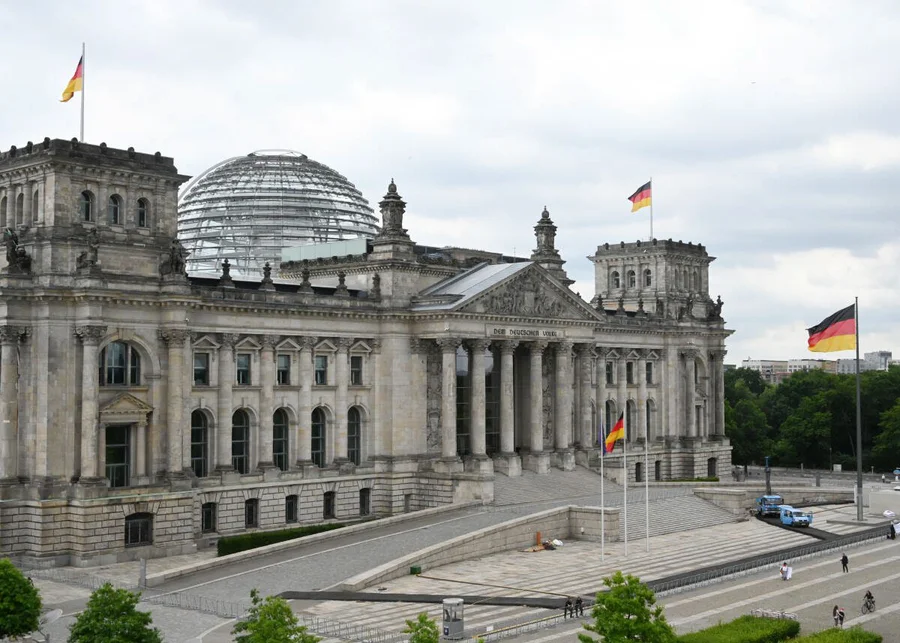
Image: © Deutscher Bundestag/Achim Melde - the seat of the Bundestag (federal parliament) in Berlin – Correct answer
- the Federal Constitutional Court in Karlsruhe
- the Bundesrat (federal council) building in Berlin
- the Federal Chancellery in Berlin
In the test (German): den Bundestagssitz in Berlin
View this questionQuestion 57
Who is usually elected President of the German Bundestag (federal parliament)?
Wer wird meistens zur Präsidentin/zum Präsidenten des Deutschen Bundestages gewählt?
- the oldest member of parliament
- the Minister-President of the largest federal state
- a former Federal Chancellor
- a member of the strongest parliamentary group – Correct answer
In the test (German): eine Abgeordnete/ein Abgeordneter der stärksten Fraktion
View this questionQuestion 58
Who appoints the ministers of the federal government in Germany?
Wer ernennt in Deutschland die Ministerinnen/die Minister der Bundesregierung?
- the President of the Federal Constitutional Court
- the Federal President – Correct answer
- the President of the Bundesrat (federal council)
- the President of the Bundestag (federal parliament)
In the test (German): die Bundespräsidentin/der Bundespräsident
View this questionQuestion 60
In Germany, the Bundestag (federal parliament) and the Bundesrat (federal council) belong to the …
In Deutschland gehören der Bundestag und der Bundesrat zur …
- executive.
- legislature. – Correct answer
- directive.
- judiciary.
In the test (German): Legislative.
View this questionQuestion 63
What is not part of the executive in Germany?
Was gehört in Deutschland nicht zur Exekutive?
- the police
- the courts – Correct answer
- the tax office
- the ministries
In the test (German): die Gerichte
View this questionQuestion 64
Today, the Federal Republic of Germany is divided into …
Die Bundesrepublik Deutschland ist heute gegliedert in …
- four occupation zones.
- an eastern state and a western state.
- 16 cantons.
- the Federation, the federal states and the municipalities. – Correct answer
In the test (German): Bund, Länder und Kommunen.
View this questionQuestion 65
It is not one of the tasks of the German Bundestag (federal parliament) to …
Es gehört nicht zu den Aufgaben des Deutschen Bundestages, …
- draft laws.
- monitor the federal government.
- elect the Federal Chancellor.
- form the federal cabinet. – Correct answer
In the test (German): das Bundeskabinett zu bilden.
View this questionQuestion 67
In Germany, what is primarily a responsibility of the federal states?
Was ist in Deutschland vor allem eine Aufgabe der Bundesländer?
- Defence policy
- Foreign policy
- Economic policy
- School policy – Correct answer
In the test (German): Schulpolitik
View this questionQuestion 69
The Federal Republic of Germany has a three-tier administrative structure. What is the lowest political tier called?
Die Bundesrepublik Deutschland hat einen dreistufigen Verwaltungsaufbau. Wie heißt die unterste politische Stufe?
- City councils
- District administrators
- Municipalities – Correct answer
- District offices
In the test (German): Gemeinden
View this questionQuestion 70
German Federal President Gustav Heinemann hands Helmut Schmidt his certificate of appointment as German Federal Chancellor in 1974. What is one of the duties of the German Federal President?
Der deutsche Bundespräsident Gustav Heinemann gibt Helmut Schmidt 1974 die Ernennungsurkunde zum deutschen Bundeskanzler. Was gehört zu den Aufgaben der deutschen Bundespräsidentin/des deutschen Bundespräsidenten?
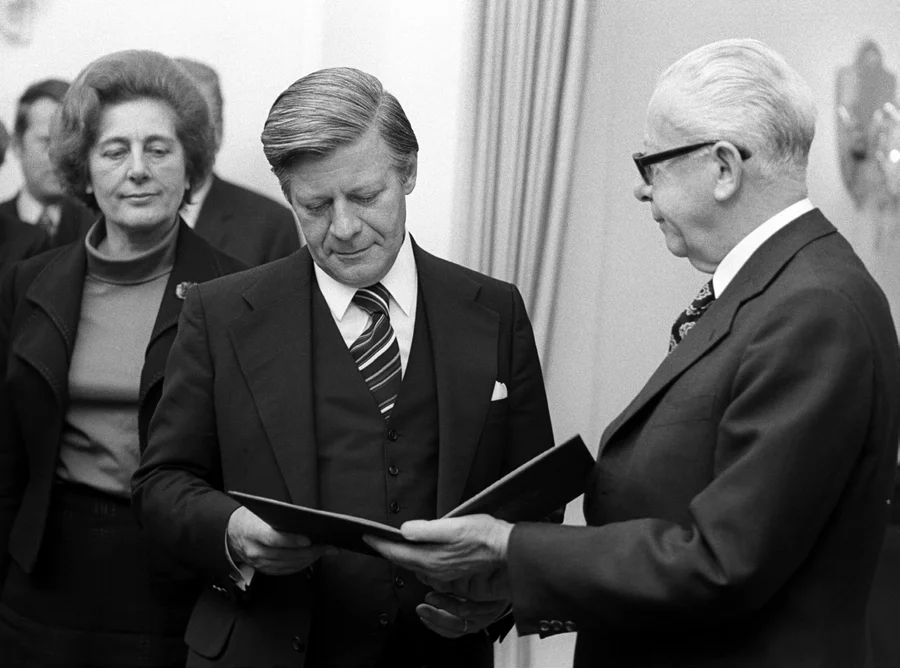
Image: © Bundesregierung/Engelbert Reineke - They conduct the business of government.
- They monitor the governing party.
- They select the ministers.
- They propose the Chancellor for election. – Correct answer
In the test (German): Sie/Er schlägt die Kanzlerin/den Kanzler zur Wahl vor.
View this questionQuestion 71
Where does the German Federal Chancellor spend most of their time? Most of the time they are …
Wo hält sich die deutsche Bundeskanzlerin/der deutsche Bundeskanzler am häufigsten auf? Am häufigsten ist sie/er …
- in Bonn, because that is where the Federal Chancellery and the Bundestag (federal parliament) are located.
- at Schloss Meseberg, the federal government's guest house, to receive state guests.
- at Schloss Bellevue, the official residence of the Federal President, to receive state guests.
- in Berlin, because that is where the Federal Chancellery and the Bundestag (federal parliament) are located. – Correct answer
In the test (German): in Berlin, weil sich dort das Bundeskanzleramt und der Bundestag befinden.
View this questionQuestion 72
What is the name of the current Federal Chancellor of Germany?
Wie heißt die jetzige Bundeskanzlerin/der jetzige Bundeskanzler von Deutschland?
- Gerhard Schröder
- Angela Merkel
- Ursula von der Leyen
- Friedrich Merz – Correct answer
In the test (German): Friedrich Merz
View this questionQuestion 74
What is the parliament for the whole of Germany called?
Wie heißt das Parlament für ganz Deutschland?
- Federal Convention (Bundesversammlung)
- People's Chamber (Volkskammer)
- Bundestag – Correct answer
- Federal Court of Justice (Bundesgerichtshof)
In the test (German): Bundestag
View this questionQuestion 75
What is the name of Germany's current head of state?
Wie heißt Deutschlands heutiges Staatsoberhaupt?
- Frank-Walter Steinmeier – Correct answer
- Bärbel Bas
- Bodo Ramelow
- Joachim Gauck
In the test (German): Frank-Walter Steinmeier
View this questionQuestion 77
What is the Bundeswehr?
Was ist die Bundeswehr?
- the German police
- a German port
- a German citizens' initiative
- the German army – Correct answer
In the test (German): die deutsche Armee
View this questionQuestion 80
Which court in Germany is responsible for interpreting the Basic Law (Grundgesetz)?
Welches Gericht in Deutschland ist zuständig für die Auslegung des Grundgesetzes?
- Higher Regional Court
- Local Court
- Federal Constitutional Court – Correct answer
- Administrative Court
In the test (German): Bundesverfassungsgericht
View this questionQuestion 81
Who elects the Federal Chancellor in Germany?
Wer wählt die Bundeskanzlerin/den Bundeskanzler in Deutschland?
- the Bundesrat (federal council)
- the Federal Convention
- the people
- the Bundestag (federal parliament) – Correct answer
In the test (German): der Bundestag
View this questionQuestion 82
Who heads the German federal cabinet?
Wer leitet das deutsche Bundeskabinett?
- the President of the Bundestag (federal parliament)
- the Federal President
- the President of the Bundesrat (federal council)
- the Federal Chancellor – Correct answer
In the test (German): die Bundeskanzlerin/der Bundeskanzler
View this questionQuestion 83
Who elects the German Federal Chancellor?
Wer wählt die deutsche Bundeskanzlerin/den deutschen Bundeskanzler?
- the people
- the Federal Convention
- the Bundestag (federal parliament) – Correct answer
- the federal government
In the test (German): der Bundestag
View this questionQuestion 84
What is the main task of the German Federal President? They …
Welche Hauptaufgabe hat die deutsche Bundespräsidentin/der deutsche Bundespräsident? Sie/Er …
- govern the country.
- draft the laws.
- represent the country. – Correct answer
- monitor compliance with the laws.
In the test (German): repräsentiert das Land.
View this questionQuestion 85
Who makes up the German Bundesrat (federal council)?
Wer bildet den deutschen Bundesrat?
- the members of the Bundestag (federal parliament)
- the ministers of the federal government
- the government representatives of the federal states – Correct answer
- the party members
In the test (German): die Regierungsvertreter der Bundesländer
View this questionQuestion 86
Who elects the Federal President in Germany?
Wer wählt in Deutschland die Bundespräsidentin/den Bundespräsidenten?
- the Federal Convention – Correct answer
- the Bundesrat (federal council)
- the Federal Parliament
- the Federal Constitutional Court
In the test (German): die Bundesversammlung
View this questionQuestion 87
Who is the head of state of the Federal Republic of Germany?
Wer ist das Staatsoberhaupt der Bundesrepublik Deutschland?
- the Federal Chancellor
- the Federal President – Correct answer
- the President of the Bundesrat (federal council)
- the President of the Bundestag (federal parliament)
In the test (German): die Bundespräsidentin/der Bundespräsident
View this questionQuestion 90
The German federal states participate in federal legislation through …
Die deutschen Bundesländer wirken an der Gesetzgebung des Bundes mit durch …
- the Bundesrat (federal council). – Correct answer
- the Federal Convention.
- the Bundestag (federal parliament).
- the federal government.
In the test (German): den Bundesrat.
View this questionQuestion 91
In Germany, a change of government in a federal state can have an impact on federal politics. Governing becomes …
In Deutschland kann ein Regierungswechsel in einem Bundesland Auswirkungen auf die Bundespolitik haben. Das Regieren wird …
- more difficult if this changes the majority in the Bundestag (federal parliament).
- easier if this brings new parties into the Bundesrat (federal council).
- more difficult if this changes the majority in the Bundesrat (federal council). – Correct answer
- easier if it is a wealthy federal state.
In the test (German): schwieriger, wenn dadurch die Mehrheit im Bundesrat verändert wird.
View this questionQuestion 102
With what can a person be honoured in the Federal Republic of Germany if they have made a special achievement in the political, economic, cultural, intellectual or social field? With the …
Womit kann man in der Bundesrepublik Deutschland geehrt werden, wenn man auf politischem, wirtschaftlichem, kulturellem, geistigem oder sozialem Gebiet eine besondere Leistung erbracht hat? Mit dem …
- Federal Cross of Merit – Correct answer
- Federal Eagle
- Patriotic Order of Merit
- honorary title "Hero of the German Democratic Republic"
In the test (German): Bundesverdienstkreuz
View this questionQuestion 131
In Germany, a mayor is …
In Deutschland ist eine Bürgermeisterin/ein Bürgermeister …
- the director of a school.
- the boss of a bank.
- the head of a municipality. – Correct answer
- the chair of a party.
In the test (German): das Oberhaupt einer Gemeinde.
View this questionQuestion 143
A judge in Germany belongs to the …
Eine Richterin/ein Richter in Deutschland gehört zur …
- judiciary. – Correct answer
- executive.
- operative.
- legislature.
In the test (German): Judikative.
View this questionQuestion 144
In Germany, a judge belongs to the …
Eine Richterin/ein Richter gehört in Deutschland zur …
- executive power.
- judicial power. – Correct answer
- planning power.
- legislative power.
In the test (German): rechtsprechenden Gewalt.
View this questionQuestion 145
In Germany, state power is divided. For which branch of state power does a judge work? For the …
In Deutschland wird die Staatsgewalt geteilt. Für welche Staatsgewalt arbeitet eine Richterin/ein Richter? Für die …
- judiciary – Correct answer
- executive
- press
- legislature
In the test (German): Judikative
View this questionQuestion 212
What is Germany's full name?
Wie heißt Deutschland mit vollem Namen?
- Federal State of Germany (Bundesstaat Deutschland)
- Federal States of Germany (Bundesländer Deutschland)
- Federal Republic of Germany (Bundesrepublik Deutschland) – Correct answer
- Federal District of Germany (Bundesbezirk Deutschland)
In the test (German): Bundesrepublik Deutschland
View this questionQuestion 213
How many inhabitants does Germany have?
Wie viele Einwohner hat Deutschland?
- 70 million
- 78 million
- 84 million – Correct answer
- 90 million
In the test (German): 84 Millionen
View this question
More topics
Frequently asked questions
How many questions on the German state and its institutions are in the test?
It isn't fixed. 43 of the 300 general catalogue questions belong to this topic, so with 30 general questions per test you can expect about 4 on average – sometimes more, sometimes fewer.
What is the difference between the Bundestag, the Bundesrat and the Bundesversammlung?
The Bundestag is the parliament elected by the people; the Bundesrat (federal council) represents the state governments. The Bundesversammlung (Federal Convention) consists of all members of the Bundestag plus the same number of members chosen by the state parliaments, and meets only to elect the Federal President.
Who has more power, the Chancellor or the Federal President?
The Federal Chancellor leads in political terms: they head the government and set its policy guidelines. The Federal President is head of state but has mainly representative duties.
Keep reading
- Knowledge for the testGermany's political system explained simplyBundestag, Bundesrat, federal government, president and constitutional court: who decides what in Germany, explained simply for the citizenship test.
- Knowledge for the testGermany's 16 federal states and their capitalsAll 16 German states with their capitals, parliaments and heads of government in one table, plus memory aids and classic traps in the citizenship test.
- Test questions by topicCitizenship test questions on elections and political partiesVoting rights, first and second votes, parties and coalitions: every citizenship test question about elections, with the correct answer.
This guide is not legal advice. Laws and administrative practice can change; your naturalisation authority's information is binding.